
" height="55px" id="EIENBTBsE" transform="translate(0.133 10.125)" width="256.29152989446084px"/></svg>)


OLAF sells menswear, womenswear, and accessories across seasonal and core collections. Its range gives customers opportunities to return for another wardrobe staple, a different color, or pieces that complete an outfit. The brand’s “Friends” language also carries into the shopping experience, where membership begins with an invitation to become a friend.
Together connects those purchases through points and clearly stated rewards. Customers can see what a product contributes before buying, then use accumulated points toward a later qualifying order.
The Problem This Blueprint Solves: Make Reward Progress Influence the Next Purchase
A points balance has limited influence if customers only remember it after checkout. To support another order, the program needs to make both earning potential and redemption value understandable while customers are deciding what to buy.
OLAF addresses both sides. Product pages display the points an item earns, while the loyalty page explains the rewards available and the order value required to use each one.
That creates a connection between the current purchase and the next. Customers can see how shopping builds future value, while redemption gives them a reason to return with a qualifying basket.
The Blueprint: Show the Value and Give the Next Order a Target
Together combines visible earning with a reward ladder that supports repeat purchasing and higher-value orders.
1. Make Earning Part of the Product Decision
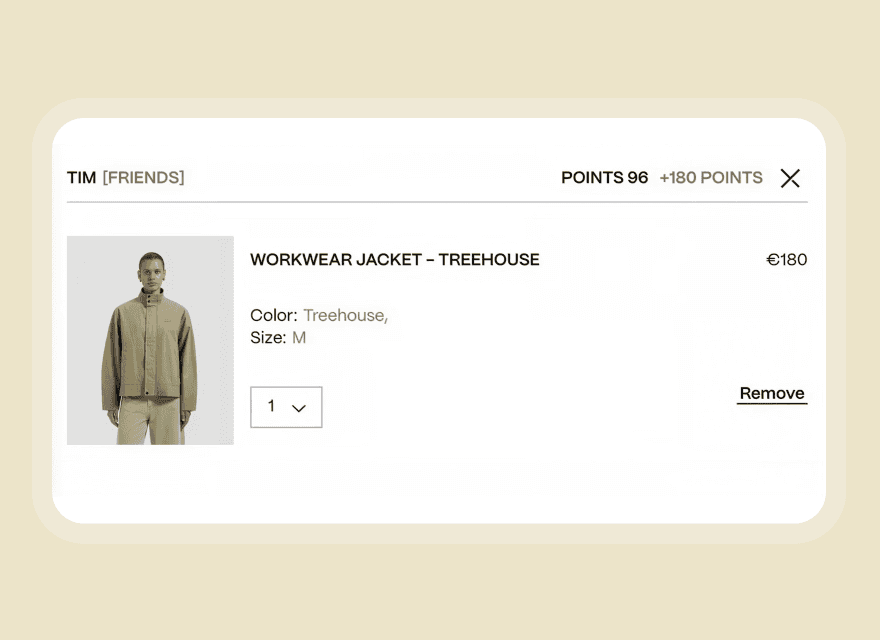
OLAF shows earning potential directly on product pages. For example, a €170 knitwear item displays that buying it earns 170 points.
This places loyalty alongside the product’s price and details. A customer does not need to visit a separate account page to understand what the purchase contributes.
For OLAF, that makes membership relevant before checkout. The product provides value now, while the points create another reason to keep future purchases with the brand.
2. Pair Each Reward With a Qualifying Basket
The reward ladder combines a points requirement with an order threshold. Larger discounts require both more accumulated points and a higher-value order.
That gives redemption a role in basket building. A member who has enough points still needs an eligible order, creating a reason to consider another piece when their basket falls below the requirement.
The thresholds also make the exchange explicit. Customers know what they can receive and what purchase is required, rather than discovering the conditions only when attempting to redeem.
3. Carry Earned Value Into a Later Purchase
Points become redeemable 30 days after they are received. Together therefore creates a distinction between earning value and using it.
For customers, the purchase leaves something useful behind for a later shopping occasion. For OLAF, that provides a reason to return after the initial order rather than treating loyalty solely as a discount on the transaction already happening.
Rewards apply to full-price products only. This keeps redemption focused on eligible purchases and gives the brand a defined boundary around where loyalty discounts can be used.


Two Targets Behind Every Redemption
Together asks members to meet two different requirements: an accumulated points balance and a qualifying order value.
Those requirements serve different purposes. Points connect earlier purchases to the relationship, while the order threshold shapes the purchase on which the reward is used.
This makes the program useful for more than retention alone. A customer can return because they have earned a reward, then build a larger basket to use it. The mechanic supports both another order and the value of that order, without assuming every member will respond in the same way.
How It Works
Joining and earning
Customers create an account to become a member. Purchases earn 1 point per €1 spent, and product pages show the earning potential of individual items.
Choosing a reward
The published reward ladder includes:
250 points: €25 off orders above €150
500 points: €50 off orders above €200
750 points: €75 off orders above €250
1,000 points: €100 off orders above €300
Redeeming
Members log in and select an eligible reward at checkout. Points can be redeemed 30 days after receipt, and rewards apply to full-price products only.
What This Blueprint Achieves
Together gives OLAF a practical way to connect repeat purchasing with basket value.
Product-page earning information makes loyalty visible during consideration. Accumulated points give members value to return for, while the redemption thresholds create a reason to build an eligible order.
The full-price restriction also sets a clear limit on discount eligibility. It illustrates how a program can encourage another purchase while controlling which products receive the reward, rather than applying loyalty savings indiscriminately.

The Takeaway
Together shows how straightforward points can become more commercially useful through visibility and redemption conditions.
Customers see what they earn before buying, carry that value into a later purchase, and understand the basket required to use it.
For fashion and e-commerce brands, it is a useful blueprint for encouraging return orders and larger baskets while keeping reward eligibility clearly defined.









































